
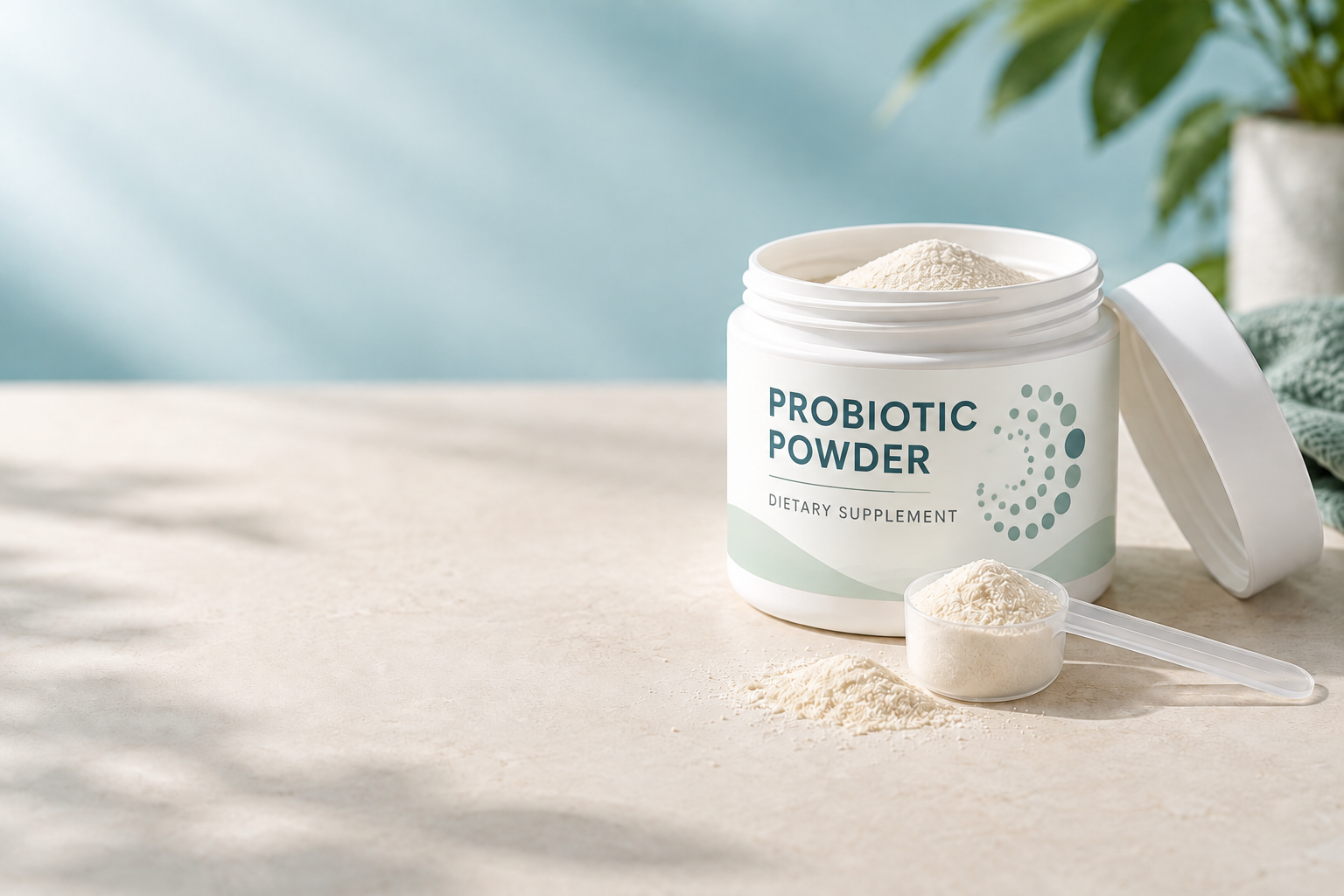
A probiotic product brief has to do more than name a few familiar organisms and select an impressive CFU number. The brief must connect a specific strain or strain blend to a defensible product position, define how much viable material must remain through the end of shelf life, account for losses during production and storage, and choose a dosage form and package that protect the product under real distribution conditions. If those decisions are not aligned, a quote may look complete while the product itself is still commercially undefined.
For brand teams evaluating probiotic contract manufacturing, the most useful early conversation is not simply, “Can you make a 50-billion-CFU probiotic?” It is, “Which strains support the intended consumer and claims, what CFU must be guaranteed at expiration, what manufacturing and stability assumptions support that guarantee, and what package can preserve it?” Those questions move the project from marketing shorthand to a specification that R&D, quality, procurement, and operations can manage.
This guide is written for supplement brand owners, product managers, sourcing teams, and quality leaders preparing a capsule or powder probiotic for the U.S. market. It explains the commercial decisions that should be settled before formula approval, then shows how to convert them into a quote-ready brief. The central principle is simple: buy a verified product system, not a headline CFU number. Strain identity, potency, process exposure, packaging, testing, and shelf life must work together.
Define the Commercial Product Before You Request a Quote

Start With the Consumer and the Use Occasion
A manufacturer can recommend a process only after the brand defines who will use the product, why they will use it, how often they will take it, and where the product will be sold. A daily adult digestive capsule has a different product brief from a children’s powder stick, a shelf-stable travel product, or a refrigerated professional-channel formula. The audience affects the serving size, capsule count, flavor expectations, allergen limits, package format, caution language, and acceptable storage instructions.
Write the consumer promise in plain business language before discussing individual strains. For example: a once-daily shelf-stable capsule for adults who want digestive support, sold primarily through U.S. e-commerce, with a two-year target shelf life and no refrigeration. That sentence gives the development team more direction than a long ingredient wish list. It also exposes conflicts early. A refrigerated strain, a moisture-sensitive prebiotic, a large serving, and a two-year ambient shelf-life target may not belong in the same concept without additional cost or compromise.
Translate Positioning Into Measurable Requirements
The commercial brief should define target markets, dosage form, serving size, strain disclosure expectations, CFU claim, shelf-life target, storage statement, excluded excipients, certification needs, packaging preferences, launch volume, annual forecast, and target cost. It should also separate nonnegotiable requirements from preferences. If the capsule must be vegetarian, say so. If the label can change from 50 billion to 30 billion CFU when stability data supports a more reliable claim, record that flexibility instead of forcing development around an arbitrary number.
The same discipline applies to claims. A brand may want digestive, immune, regularity, women’s health, or general microbiome positioning, but product and labeling decisions need evidence appropriate to the selected strains, dose, and intended use. Higher CFU alone does not establish a stronger product. The strain, delivered amount, supporting evidence, and consumer instructions need to tell one coherent story.
Select Probiotic Strains for Evidence, Identity, and Supply

Treat the Strain Designation as a Material Identity
Probiotic effects can be strain-specific, which is why a complete identity matters. The NIH Office of Dietary Supplements probiotic fact sheet explains that probiotics are identified by genus, species, and strain designation. For a commercial formula, the strain code is not decorative label copy; it connects the material to supplier documentation, published evidence, manufacturing behavior, specifications, and testing. Substituting another strain from the same species can change the evidence base and may change stability or processing performance.
Ask the supplier or manufacturer to document the current taxonomy, strain designation, source, specification, allergen and carrier information, country of origin, storage conditions, retest or expiration period, and supporting identity method. If older studies use a former genus name, the label and substantiation file should reconcile the naming clearly so customers and reviewers can recognize the organism without creating ambiguity.
Choose Single-Strain or Multi-Strain on Purpose
A single-strain product can create a clean evidence story, simpler potency allocation, and more straightforward troubleshooting. A multi-strain blend may support broader positioning or portfolio differentiation, but each additional organism adds sourcing, blend uniformity, potency allocation, stability, testing, and labeling questions. A long strain list is not automatically a stronger formula. It can reduce the CFU allocated to each strain and make end-of-shelf-life verification more complex.
Confirm Commercial Availability Before Formula Lock
A strain may be scientifically attractive but commercially impractical if it has a high supplier minimum, long lead time, narrow shipping window, licensing restriction, limited backup supply, or short remaining shelf life when delivered. Ask whether the material is sold as a pure culture, a standardized concentrate, or a premix with carriers. The carrier system affects formula weight, allergen review, label declarations, and blend behavior. Confirm whether the quoted potency is typical, minimum at release, or minimum through the raw material’s expiration period.
Set the Label CFU and Overage Strategy Together
| Decision Area | Single-Strain Formula | Multi-Strain Formula | Buyer Question |
|---|---|---|---|
| Evidence story | Usually easier to connect the formula to strain-specific evidence. | Requires a rationale for the blend and the amount of each organism. | Does the evidence match the exact strain and intended dose? |
| Potency target | One organism carries the full CFU target. | Total CFU must be allocated across strains with clear minimums. | Is CFU guaranteed in total, by strain, or both? |
| Supply chain | Fewer qualified materials and supplier variables. | More materials, lead times, storage needs, and substitution risk. | What happens if one strain is delayed or discontinued? |
| Testing | Identity and enumeration may be more direct. | Enumeration and differentiation can be technically more demanding. | Can the method verify what the label promises? |
| Stability | One strain’s loss profile drives the potency model. | Different strains may decline at different rates. | Which strain sets the worst-case shelf-life limit? |
Decide What the Label Will Guarantee
CFU, or colony-forming units, is used to express viable microorganisms under defined test conditions. For a brand team, the critical commercial question is the timing of the guarantee. A statement such as “50 billion CFU at manufacture” does not tell the customer what remains near expiration. A stronger development brief defines the CFU commitment at the end of shelf life, subject to labeled storage conditions, and specifies whether the number applies to the total blend or to individual strains.
The target should be connected to the formula’s rationale, not selected only for shelf impact. NIH notes that products with higher CFU counts are not necessarily more effective than products with lower counts. The chosen level should reflect the strain, intended use, serving size, evidence, and product design. It must also fit within capsule volume or powder serving limits after carriers and complementary ingredients are included.
Model CFU Overage as a Controlled Input
A CFU overage is the additional viable count introduced so the finished product can remain at or above its label target through the intended shelf life. It is not a universal percentage and should not be copied from another formula. The appropriate starting potency depends on strain-specific decline, incoming material potency, manufacturing exposure, water activity, oxygen, package barrier, storage temperature, test variability, and the length of the guarantee.
A useful model works backward from the end-of-shelf-life requirement. The team sets the label minimum, reviews available stability data, estimates losses through weighing, blending, filling, packaging, and storage, then defines release and in-process targets with justified tolerances. The model should distinguish a planned overage from uncontrolled process variation. If the manufacturer simply adds a large cushion without data, the brand may pay for unnecessary culture, face capsule-size pressure, or create a potency profile that is difficult to reproduce.
Ask for the Assumptions Behind the Number
When comparing quotations, request the raw-material potency assumption, calculation basis, expected process loss, release specification, end-of-shelf-life specification, stability conditions, test method, and rounding convention. Ask how much of the quoted CFU comes from intentional overage and how much comes from the supplier’s normal potency range. Two quotes that both say “50 billion CFU” may use very different culture quantities, test plans, and shelf-life assumptions.
Protect Viability During Manufacturing

Map Every Exposure From Receiving Through Packaging
Live microorganisms can be affected by heat, moisture, oxygen, compression, shear, hold time, and contact with other ingredients. A practical process review maps each exposure: receiving, quarantine, refrigerated or controlled storage, staging, weighing, sieving, blending, transfer, encapsulation or filling, metal detection, bulk holding, packaging, finished-goods storage, and transport. The review should identify maximum temperatures, humidity controls, open-container time, sanitation status, and how long material may wait between steps.
Process design should reduce avoidable exposure rather than depend on a large overage to absorb poor handling. Cultures may need to enter the blend late, be handled in a low-humidity room, or be protected from high-energy mixing. Long hold times in warm production areas can matter even when the main filling operation is gentle. Define start and finish times, environmental limits, and disposition rules when a limit is exceeded.
Manage Ingredient Compatibility, Not Just Strain Stability
The probiotic is only one part of the formula. Hygroscopic fibers, mineral salts, botanical extracts, flavors, acids, sweeteners, enzymes, and residual moisture can change the local environment during storage. A prebiotic may support the product concept but complicate moisture control or powder flow. A flavored powder may require taste-masking materials that increase water activity or processing steps. Compatibility should be evaluated in the complete formula, not inferred from the stability of the culture alone.
Consider physical segregation as well. Probiotic concentrates can represent a small portion of a large batch, and carrier particle size or density may differ from other ingredients. The blending sequence, premix design, equipment load, sampling plan, and acceptable hold time should support uniform distribution. A uniform total powder weight does not prove uniform CFU across servings.
Match the Dosage Form to the Risk Profile

Capsules offer a familiar unit dose and can limit direct consumer exposure to flavor, while powder formats provide flexible serving sizes and can support sticks, sachets, or tubs. Innova Nutra’s capsule manufacturing and powder manufacturing capabilities allow the format discussion to begin with the product requirements rather than a single production line. The decision should consider dose volume, consumer routine, moisture exposure after opening, flavor, portability, packaging barrier, fill-weight control, and expected use period.
Is Your Probiotic Product Ready for Commercial-Scale Manufacturing?
A strong label claim depends on more than the starting CFU count. Innova Nutra can review your strain selection, potency targets, manufacturing overages, process exposure, packaging barrier, and shelf-life plan—helping your brand identify viability risks before commercial production begins.
Build Packaging and Shelf Life as One System
Choose Packaging for Barrier Performance
Probiotic packaging is not simply a branding choice. The bottle, blister, pouch, or stick must manage the moisture and oxygen exposure expected during filling, warehousing, shipping, retail, and consumer use. Review container material, wall thickness, closure, liner, induction seal, desiccant, oxygen absorber where appropriate, headspace, serving count, and the number of times the package will be opened. A large bottle with a long in-use period may expose the remaining servings far more often than a single-serve sachet.
The package specification should identify component suppliers, resin or film structure, barrier attributes, dimensions, torque or seal requirements, and inspection criteria. If a desiccant is used, define its type, capacity, placement, compatibility, and inclusion check. Packaging decisions should be frozen early enough for stability units to use representative commercial components. Testing a formula in a high-barrier laboratory container and later selling it in a different bottle creates evidence that may not reflect the marketed product.

Define Shelf Life With a Protocol and Acceptance Criteria
A shelf-life target is a business objective until supported by product-specific data. The stability plan should identify the commercial formula and package, storage conditions, pull points, methods, sample quantities, and acceptance criteria. CFU is central, but the protocol may also address moisture or water activity, appearance, odor, capsule integrity, powder flow, package condition, contaminants, and other attributes relevant to the formula and dosage form.
Accelerated data can support development decisions, but it should not be treated as a universal conversion into real-time shelf life. Live cultures may not decline linearly, and strains in the same blend may respond differently. Use available strain and package data to set a responsible initial plan, continue real-time studies, and define what happens if results approach the specification. The brand and manufacturer should agree on who owns the protocol, who reviews results, and who approves any shelf-life extension.
Design for Distribution and Consumer Use
The labeled storage statement must match the evidence and the route to market. A product can leave the factory within specification and still lose viability during a hot parcel-delivery cycle, uncontrolled warehouse stay, or extended time in a consumer’s kitchen. Review seasonal shipping, pallet and parcel exposure, international lanes, fulfillment-center conditions, and whether cold-chain handling is realistic. If refrigeration is required, the logistics, retailer communication, and consumer instructions need to be built into the commercial model.
In-use conditions matter too. A tub opened daily for sixty days faces a different exposure pattern from a sealed stick pack. The number of servings per container, closure discipline, scoop handling, and presence of a moisture-control component all influence the risk. Packaging should protect the product that consumers actually use, not only the unopened unit submitted for initial testing.
Qualify the Manufacturer, Testing Plan, and Documentation
Look Beyond a Generic GMP Statement
Dietary supplement manufacturing is subject to applicable current good manufacturing practice requirements, including 21 CFR Part 111 in the United States. A serious probiotic supplement manufacturer should be prepared to discuss facility controls, material quarantine, environmental management, sanitation, allergen programs, traceability, batch documentation, deviations, change control, release authority, and complaint handling. Certifications can support qualification, but they do not replace a product-specific review of live-culture capabilities.
Ask how the facility prevents culture mix-ups and cross-contamination, maintains required storage, monitors production conditions, and manages open exposure. Review whether the equipment and room controls fit the planned batch size and dosage form. A process that works for a short capsule run may not transfer directly to a flavored powder with long blending and packaging times. The manufacturer should identify the steps most likely to affect viability and show how they are controlled.
Align Specifications With Methods and Sampling
A specification is only as useful as the method and sampling plan behind it. Confirm the identity approach, enumeration method, sample preparation, incubation conditions, reporting units, rounding rules, method suitability, and laboratory qualifications. In multi-strain products, ask whether the method reports total viable count or can distinguish organisms. If the label or formula specification makes strain-level promises that the method cannot verify, close that gap before release criteria are finalized.
Sampling also needs a rationale. The team should know where in the process samples are taken, how many containers or locations are represented, and whether the sample can detect blend or fill variation. Retain samples, stability samples, and reserve quantities should be included in the batch and cost model. The Certificate of Analysis should report the specifications and results that matter to the approved product, not merely a generic list of tests.
Clarify Ownership Before the First Batch
The quality agreement or commercial contract should clarify who approves suppliers, formula revisions, specifications, methods, artwork, packaging components, and deviations. It should define notification expectations for supplier, taxonomy, process, facility, method, or component changes. It should also address stability ownership, out-of-specification investigations, complaint support, recalls, document retention, and access to relevant batch records or summaries.
Turn the Concept Into a Quote-Ready Manufacturing Brief
Provide Inputs That Make the Quote Comparable
Send prospective manufacturers the same controlled request. Include target consumer and positioning, exact strains or evidence requirements, dosage form, CFU per serving at end of shelf life, serving size, excipients and exclusions, shell or flavor preferences, target markets, certifications, package concept, count, shelf-life target, storage statement, testing expectations, launch quantity, annual forecast, destination, and desired date. Identify which items are fixed and which can be optimized.
Request a written assumptions list with the quotation. It should state culture potency, overage basis, expected yield, scrap allowance, included tests, stability work, sample rounds, component minimums, tooling, freight assumptions, and lead-time starting point. Ask whether quoted materials are in stock, reserved, or subject to supplier confirmation. A lower unit price can conceal excess component inventory, excluded testing, or a shelf-life assumption the brand did not intend.
Use Decision Gates Instead of One Final Approval
A practical program moves through defined gates: commercial brief approval, strain and supplier approval, feasibility formula, preliminary packaging selection, prototype or pilot review, specification and method approval, artwork review, commercial batch authorization, release, and ongoing stability review. Each gate should identify the decision owner, required evidence, open risks, and effect of later changes. This structure allows marketing, quality, and operations to move together without pretending that all uncertainty disappears at the sample stage.
Build contingency decisions into the plan. Decide in advance what happens if the preferred strain misses its lead time, the blend does not fit the capsule, the flavor system increases water activity, the package component minimum is too high, or accelerated stability shows faster-than-expected decline. A preapproved option is faster and less expensive than rebuilding the concept after artwork or inventory has been committed.
Evaluate the Partner on Transparency and Execution
The best contract manufacturing proposal makes risks visible. It explains what is known, what must be tested, what the brand must decide, and which assumptions could change cost or timing. Look for a team that can connect formulation, culture sourcing, process controls, analytical methods, packaging, stability, and release rather than handing each topic to a separate department without a clear owner.
References, sample products, and facility credentials are useful, but the project plan is the more direct test. Ask for the critical path, approval calendar, documentation list, communication cadence, and escalation process. A reliable partner should be able to explain why a proposed strain, CFU target, overage, format, and package fit the brief in language that commercial and quality teams can both understand.
Make the Shelf-Life Promise Before You Make the Purchase Order

A successful probiotic launch begins with a promise the full product system can keep. The strain identity supports the evidence story. The label CFU defines the consumer-facing commitment. The overage and process controls protect that commitment through manufacturing. The package and distribution plan protect it through storage and use. The specifications, methods, records, and stability program show whether the system is performing as intended.
Before placing a commercial order, the brand team should be able to answer six questions clearly: Which exact strains are being purchased? What CFU is guaranteed, and at what point in shelf life? What data supports the overage? Which manufacturing exposures are controlled? Why is the selected package suitable? How will identity, potency, stability, and changes be documented? If any answer depends on an unstated assumption, the project is not yet quote-ready.
Innova Nutra can help brands coordinate probiotic formula development, capsule or powder production, quality review, and packaging around a practical launch plan. Bring your strain preferences, target CFU, serving format, shelf-life goal, package concept, forecast, and target market to a feasibility discussion. To turn those inputs into a defined manufacturing path, contact the Innova Nutra team and request a project-specific review.
Build a Probiotic Product Designed to Stay Viable
From strain sourcing and CFU planning to capsule or powder production, testing, and protective packaging, Innova Nutra can coordinate the critical steps behind a commercially practical probiotic supplement. Share your product goals, target market, format, and launch volume to start defining the right manufacturing path.